 Cloudera
How to Build a Native NiFi Processor in Java (the Read Side of Iceberg)
Updated:
This is the third post in the custom-processor series. The first two — Custom Processors with Cloudera Streaming Operators and How to Build and Test Custom NiFi Processors with AI — are both the Python path: drop a .py file into a mounted extensions folder, wait 30 seconds, and NiFi hot-reloads it. That path is unbeatable for glue logic and iteration speed. But it can’t reach a controller service, and it isn’t the JVM. When you need either, you build a native processor: Java compiled into a NAR and loaded as a first-class type. This post is that path end to end, and the worked example is a processor I actually needed and shipped — GetIceberg, the read counterpart to NiFi’s write-only PutIceberg, returning real rows from a Cloudera Data Share table.
The symptom: NiFi’s Iceberg bundle can’t read
NiFi ships PutIceberg and PutIcebergCDC. Both write. There is no GetIceberg — no first-class way to pull the rows of an Iceberg table into a flow. On a CDP Data Share, where the whole point is that a consumer reads a shared table through a REST catalog, that gap is the whole game. You can call the REST Catalog API by hand with InvokeHTTP and an OAuth token provider — that works, and it’s the zero-dependency path — but it’s HTTP glue, not a processor. What I wanted on the canvas was a processor that takes a catalog service and a table name and emits the rows through a Record Writer, exactly the way PutIceberg takes them in.
The diagnosis: build the read counterpart as a NAR
The Python bridge can’t do this — it doesn’t do identifiesControllerService(...), and GetIceberg has to plug the same RESTCatalogService the stock bundle already uses. So it’s Java. And the fastest way to a correct Java processor here wasn’t the empty archetype — it was to port the one that already exists. I took the PutIceberg source, renamed everything Put→Get, ripped out the put guts (Kerberos/UGI wrapping, the RecordReader, task writers, commit retries) and dropped in get guts:
catalog.loadTable(id) → IcebergGenerics.read(table) → Iceberg-to-NiFi record conversion → Record Writer
The result keeps the stock bundle’s module layout, its success/failure relationships, and its controller-service contract — so on the canvas the read side and the write side look like siblings.
The processor: what makes it native
Three things a Python processor can’t do show up immediately.
It identifies controller services. The load-bearing property doesn’t take a string — it takes a controller service:
static final PropertyDescriptor CATALOG = new PropertyDescriptor.Builder()
        .name("catalog-service")
        .displayName("Catalog Service")
        .identifiesControllerService(IcebergCatalogService.class)   // dropdown of matching CS instances
        .required(true)
        .build();
That one line is why the same RESTCatalogService instance feeds both PutIceberg and GetIceberg. The Record Writer is the same idea (identifiesControllerService(RecordSetWriterFactory.class)) — so the output format is whatever writer you drop in: JSON, Avro, Parquet, CSV.
It’s a source, and it says so. Class-level annotations the framework enforces:
@PrimaryNodeOnly
@TriggerSerially
@InputRequirement(InputRequirement.Requirement.INPUT_FORBIDDEN)   // no inbound connection — it pulls from the catalog
@RequiresInstanceClassLoading(cloneAncestorResources = true)
INPUT_FORBIDDEN makes NiFi reject an inbound connection at design time. @PrimaryNodeOnly + @TriggerSerially stop a clustered NiFi from running the same full-table read on every node at once. These compile fine if you get them wrong — they just misbehave in a cluster, which is the worst place to find out.
The read runs through the session. onTrigger creates the FlowFile (a source has none to get()), scans the table, writes every row inside one session.write callback, stamps record.count / iceberg.catalog.namespace / iceberg.table.name, fires a provenance RECEIVE on the table location, and transfers to success. The entire body is wrapped in one try whose catch routes a diagnostic FlowFile to failure carrying the namespace, table, and iceberg.read.error as attributes — so when a read fails you debug from the flow, not by grepping pod logs.
Two divergences I earned the hard way
Porting the factory that builds the catalog client (IcebergCatalogFactory) is where the real lessons are. It diverges from the stock CFM factory in exactly two places, and both came out of debugging the native path on a live cluster.
Null-guard the OAuth token. The stock factory guards the token service but never the token string. When the Knox OAuth2 provider can’t mint a token — a wedged provider, or a per-user JWT quota hit (403 token limit exceeded) — the token comes back null and Iceberg throws a bare NullPointerException deep inside EnvironmentUtil.resolveAll. Nothing tells you it’s the token. So the factory checks:
if (token == null || token.isBlank()) {
    throw new IllegalStateException("The configured OAuth2 token provider returned no access token; "
            + "check that the provider is enabled and its credentials are valid");
}
Always request vended credentials. One header unlocks the datashare’s S3 read credentials on loadTable:
properties.put("header.X-Iceberg-Access-Delegation", "vended-credentials");
Without it the catalog resolves the table metadata but can’t read the data files.
 Pro Tip! These two are also exactly the notes a reviewer will want if you take this upstream: the null-token guard is a genuine robustness fix worth landing; the always-on vended-credentials header is a CDP-datashare assumption that should be made configurable before it goes into
 apache/nifi.
Prove it with TestRunner — no cluster, no credentials
nifi-mock is in the POM, so the processor is testable in-process. The trick that makes the test hermetic: it drives a local HadoopCatalog over a @TempDir, seeds the same three airlines the datashare table has (AA / DL / UA) into a real Parquet-backed Iceberg table, then reads them back.
@Test
public void testReadsAllRows() throws Exception {
    seedAirlinesTable(warehouse);          // demo.airlines, 3 rows, real Parquet
    configureRunner(warehouse);            // HadoopCatalogServiceStub + JsonRecordSetWriter
    runner.run(1);

    runner.assertAllFlowFilesTransferred(GetIceberg.REL_SUCCESS, 1);
    final MockFlowFile ff = runner.getFlowFilesForRelationship(GetIceberg.REL_SUCCESS).get(0);
    ff.assertAttributeEquals("record.count", "3");
    ff.assertAttributeEquals("mime.type", "application/json");
    assertTrue(ff.getContent().contains("American Airlines"));
}
Three tests cover the paths that matter: the happy read (3 rows, right attributes, JSON), a column projection (Columns=carrier_code → AA present, American Airlines absent), and the failure route (Table Name=does_not_exist → one FlowFile on failure with iceberg.read.error set). HadoopCatalogServiceStub is a tiny AbstractControllerService implements IcebergCatalogService — it proves the controller-service contract without a running NiFi. This is the Java version of the Python rule “prove the skeleton before you ship it.”
Measure it — a coverage plugin, and a gate
“The tests pass” and “the tests hit the code that matters” are different claims, and a coverage plugin is what separates them: it reports which lines the suite actually runs, so the branch you forgot shows up red instead of hiding behind a green build. Add JaCoCo to the processors module — prepare-agent to instrument, a report on the test phase (HTML/XML/CSV under target/site/jacoco/), and a check on verify that fails the build below a bundle line-coverage floor:
<execution><id>check</id><phase>verify</phase>
  <goals><goal>check</goal></goals>
  <configuration><rules><rule>
    <element>BUNDLE</element>
    <limits><limit><counter>LINE</counter><value>COVEREDRATIO</value><minimum>0.80</minimum></limit></limits>
  </rule></rules></configuration>
</execution>
Now mvn clean verify runs the tests and the gate — All coverage checks have been met. → BUILD SUCCESS. Two things the report taught that the checkmark didn’t. Drive the tests through the real engine, not around it: the SQL pushdown path got covered by running more SELECTs (IN, BETWEEN, IS NULL, LIKE, AND/OR/NOT, plus the non-pushable predicates that must fall back to a residual filter) through TestRunner and letting Calcite build the trees — never by hand-assembling parse nodes. And exclude what you honestly can’t test, out loud: the catalog factory’s REST branch needs a live endpoint and a real OAuth token, so it’s an explicit <exclude> on the gate with a comment — a stated decision, not a silent gap. The type converter has no such excuse, so its target is 100%.
Build the NAR — and the classloader trick that makes it drop-in
cd nifi-iceberg-read-bundle
mvn clean install -Denforcer.skip=true     # runs the TestRunner tests: 3 rows
-Denforcer.skip=true sidesteps the parent bundle’s dependency-convergence enforcer — not a real problem for a single-processor bundle. The artifact is nifi-iceberg-read-nar/target/nifi-iceberg-read-nar-1.0.2-SNAPSHOT.nar.
Two things about this NAR are the difference between “loads” and “works,” and they’re the parts that only bite in the field.
The NAR declares CFM’s Iceberg services-api NAR as its parent:
Nar-Dependency-Group: org.apache.nifi
Nar-Dependency-Id: nifi-iceberg-services-api-nar
Nar-Dependency-Version: 2.6.0.4.3.4.0-234
That’s what lets the RESTCatalogService instance already running on the cluster satisfy GetIceberg’s catalog-service property directly. Everything else — Iceberg 1.7.2, parquet, hadoop-common, jackson — is bundled inside the NAR. That bundling is deliberate:
 Danger! CFM’s stock bundle pairs
 iceberg-core 1.5.2 with jackson-databind 2.20.1, and 1.5.2 references com.fasterxml.jackson.databind.PropertyNamingStrategy$KebabCaseStrategy — a nested class removed after Jackson 2.15. Any catalog call throws ClassNotFoundException for it. Bundling my own Iceberg 1.7.2 inside the NAR sidesteps the conflict entirely — no jackson-fix image needed for this processor.
The one bootstrap step: the CFM services-api jar isn’t on any public Maven repo, so extract it from the running pod. The jars under work/nar/extensions/... are symlinks into work/nar-lib/, so stream the real file with base64 — don’t tar the directory:
POD=mynifi-0 NS=cfm-streaming V=2.6.0.4.3.4.0-234
kubectl exec $POD -n $NS -c nifi -- base64 \
  /opt/nifi/nifi-current/work/nar/extensions/nifi-iceberg-services-api-nar-$V.nar-unpacked/NAR-INF/bundled-dependencies/nifi-iceberg-services-api-$V.jar \
  | base64 -d > nifi-iceberg-services-api.jar

mvn install:install-file -Dfile=nifi-iceberg-services-api.jar \
  -DgroupId=org.apache.nifi -DartifactId=nifi-iceberg-services-api -Dversion=$V \
  -Dpackaging=jar -DgeneratePom=true
Deploy — copy the NAR, no restart
This CFM build autoloads NARs from nifi.nar.library.autoload.directory, which is ./data/extensions. Copy it straight in:
kubectl cp -c nifi nifi-iceberg-read-nar/target/nifi-iceberg-read-nar-1.0.2-SNAPSHOT.nar \
  cfm-streaming/mynifi-0:/opt/nifi/nifi-current/data/extensions/
The NAR hot-loads in ~10 seconds. Search GetIceberg in the palette and it’s there — no pod restart, no CR edit.
Watch out. NiFi will not re-register a same-version overwrite. Edit the code and copy the same 1.0.2-SNAPSHOT NAR back and nothing changes. Bump the bundle version (1.0.2 → 1.0.3), rebuild, recopy, then repoint the processor instance to the new version. That version-bump-to-redeploy rule is the Java analogue of the Python “bump ProcessorDetails.version” trick — the cost you pay for JVM speed and controller-service access.
Read a table — local first, then live
Local, no CDP credentials. The bundle ships a test-rig/: tabulario/iceberg-rest + MinIO in an iceberg-demo namespace, a pyiceberg Job that seeds demo.airlines with the three rows, and a build-demo-pg.sh that stands up the GetIcebergDemo process group over the NiFi REST API. The tabulario fixture doesn’t vend S3 config, so the demo sets io-impl / s3.endpoint / s3.path-style-access / client.region as GetIceberg dynamic properties — the escape hatch those dynamic props exist for. Result: one FlowFile, record.count=3, a JSON array of the three airlines, provenance RECEIVE s3://warehouse/demo/airlines.
Live, against a CDP Data Share. Same process group shape plus the Knox OAuth chain — three components:
-
KnoxOAuth2— aStandardOauth2AccessTokenProvider: authorization server = the Knox token endpoint, grant typeclient_credentials, Client Authentication StrategyREQUEST_BODY(Knox’s 2-step endpoint won’t take Basic). Client id/secret live in a Parameter Context, never a processor property. -
CdpRestCatalog— aRESTCatalogService:Catalog URI= the datashareiceberg-restendpoint, warehouse = the S3 path, OAuth provider =KnoxOAuth2. -
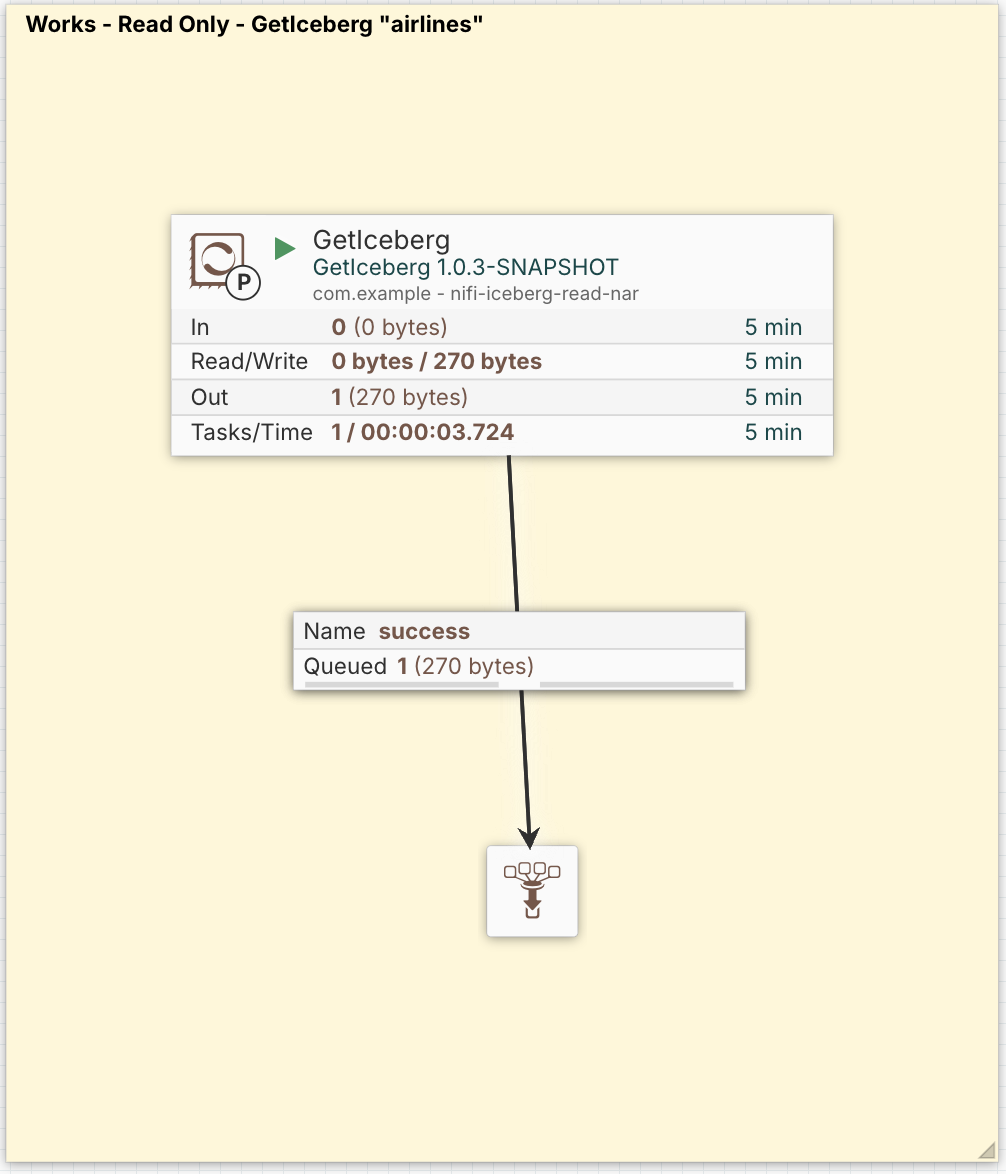
GetIceberg—Catalog Service=CdpRestCatalog,Catalog Namespace=poc_uc2,Table Name=airlines,Record Writer= aJsonRecordSetWriter→ funnel.
No dynamic S3 properties here — the datashare vends the S3 read credentials in the loadTable response, unlocked by that always-on vended-credentials header. GetIceberg on poc_uc2.airlines returns a single FlowFile whose content is a JSON array of the three airline rows — the same rows a Spark or SSB client sees through that catalog, now through a native NiFi processor with no InvokeHTTP glue. Validated on CFM 2.6.0.4.3.4.0-234.
A second processor: QueryIceberg — SQL with pushdown
GetIceberg reads a whole table. The next thing you want on a real table is to not read the whole thing — to run a WHERE and have the engine skip the files that can’t match. That’s QueryIceberg, the second processor in the same bundle: same NAR, same IcebergCatalogService, same Record Writer, but the onTrigger body runs SQL through Apache Calcite with the filter pushed down into the Iceberg scan.
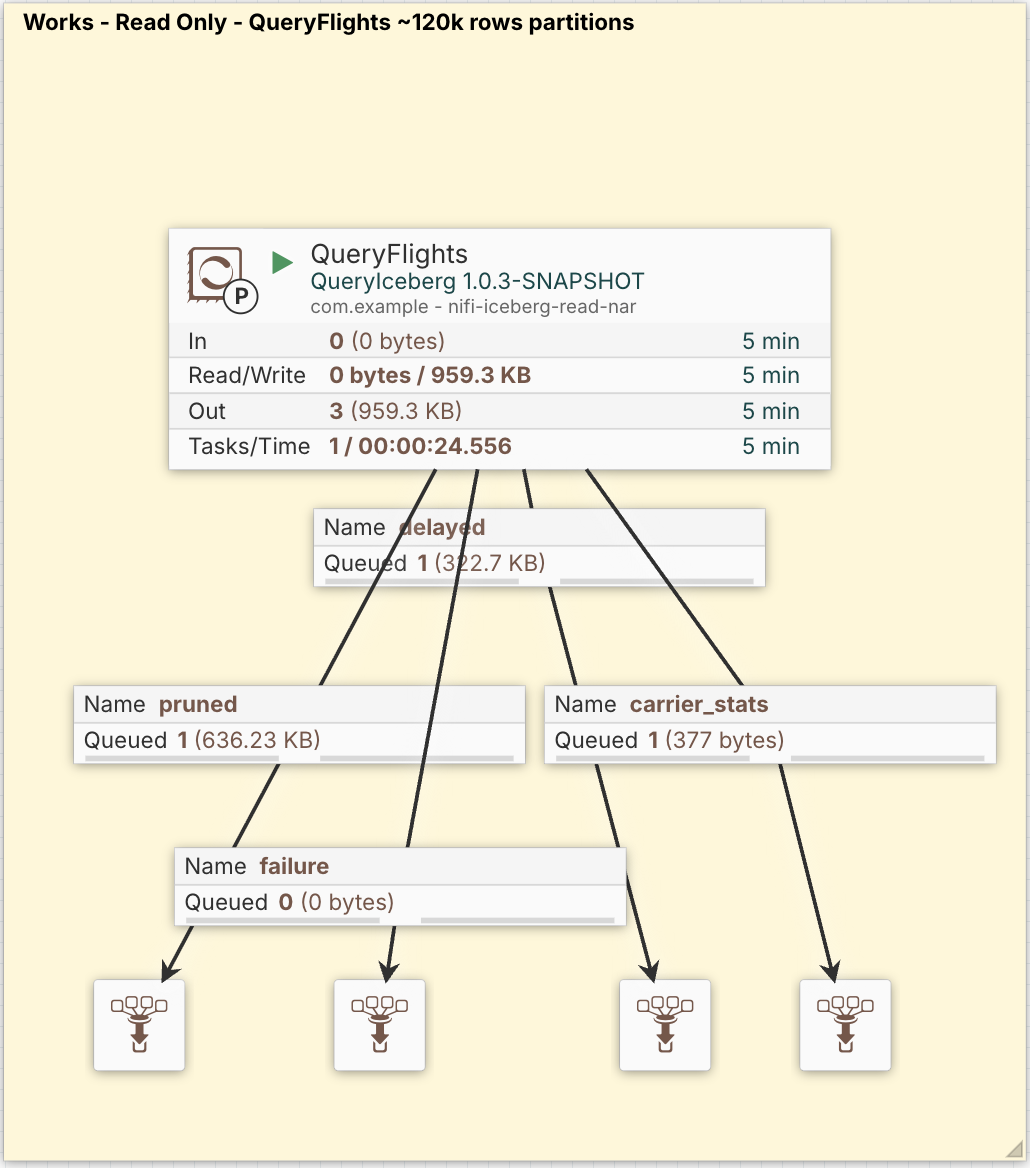
It’s shaped like NiFi’s stock QueryRecord: each dynamic property is a SQL SELECT, and its results route to a relationship of the same name. Add a property named delayed with value SELECT * FROM flights WHERE dep_delay > 45 and you get a delayed relationship carrying exactly those rows. (One wrinkle falls out of the port: GetIceberg uses plain dynamic properties for catalog overrides, but here those are the queries — so on QueryIceberg a catalog override is namespaced catalog.s3.endpoint, and everything not prefixed catalog. is treated as a query.)
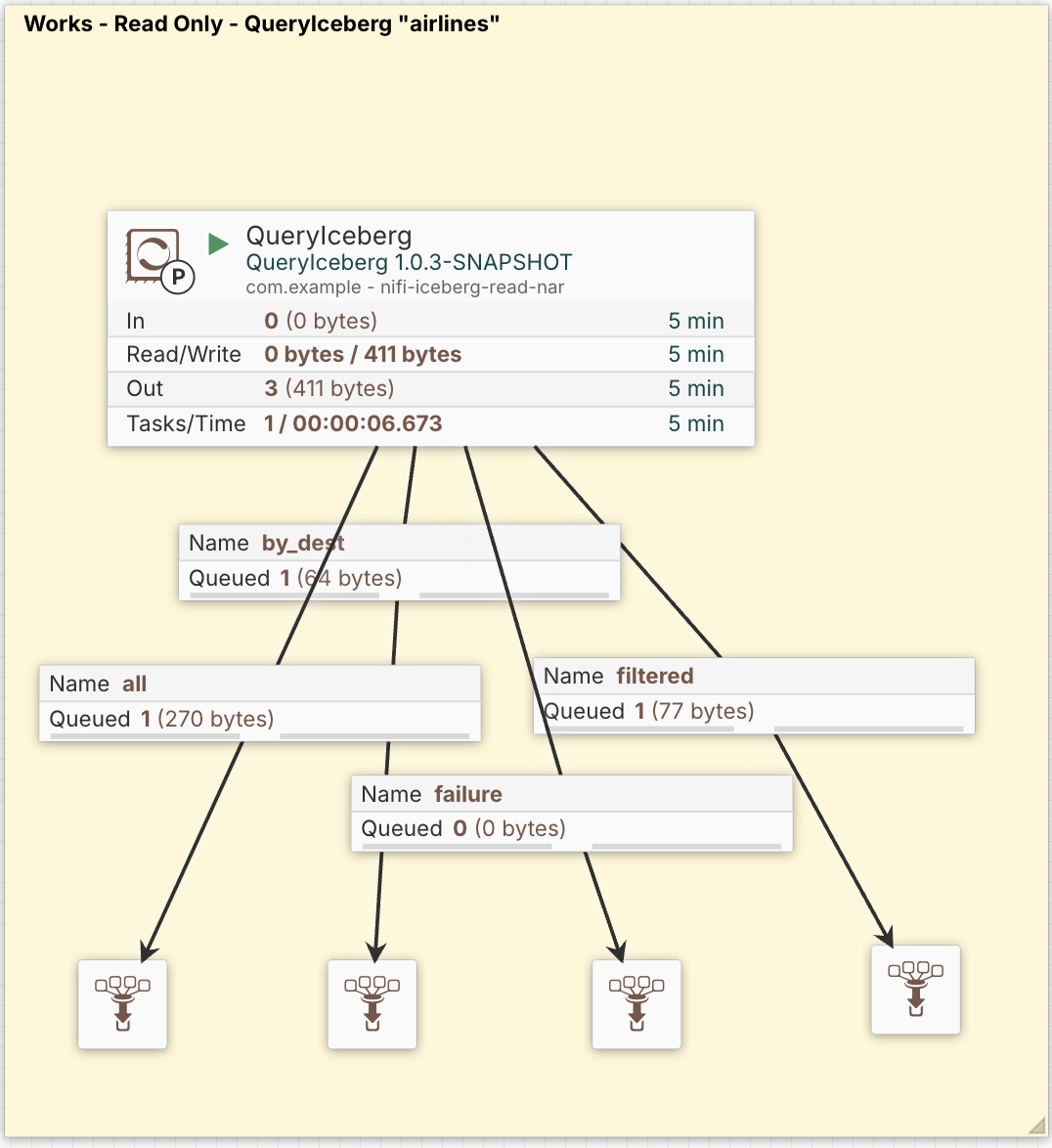
The pushdown is the whole point. The table is handed to Calcite as a ProjectableFilterableTable, whose single scan(root, filters, projects) call hands you the projected column ordinals and a mutable list of filter conjuncts. A translator turns each conjunct it understands (=, <>, <, IN, IS NULL, prefix LIKE, AND/OR/NOT over string/numeric/boolean/decimal) into a native Iceberg Expression, pushes it into the scan, and removes only what it pushed from the list — Calcite evaluates whatever’s left as a residual filter. So correctness never depends on the translator being complete: an untranslatable predicate like UPPER(carrier) = 'AA' simply stays a residual and the rows still come back right. Pushdown only ever changes how much data is read, never which rows come out.
And you can watch it work, because every FlowFile is stamped with the scan metrics: iceberg.pushdown.filter (what actually reached Iceberg — empty means the whole WHERE ran as a residual), iceberg.pushdown.columns (the projection), and the counters iceberg.scan.skipped.data.manifests / iceberg.scan.result.data.files. The test-rig/ seeds a demo.flights table of ~120k rows partitioned by month into twelve files; a query with WHERE flight_month = '2026-03' comes back with iceberg.scan.skipped.data.manifests = 11 and iceberg.scan.result.data.files = 1 — eleven-twelfths of the table never opened, proven on the FlowFile itself, and identical on the local rig and live on the CDP Data Share.
What NOT to do
-
Don’t skip the SPI file.
META-INF/services/org.apache.nifi.processor.Processormust containorg.apache.nifi.processors.iceberg.GetIceberg. No entry = the NAR loads but the processor never appears. - Don’t expect a same-version NAR to reload. Bump the version.
-
Don’t
tarthe pod’swork/nar/extensionsjars — they’re symlinks.base64the real file. - Don’t rely on the framework’s Iceberg/jackson. Classloader isolation makes it fragile and you inherit CFM’s version conflict. Bundle your own inside the NAR.
- Don’t put the OAuth client secret in a processor property. A non-sensitive property can’t reference a sensitive param anyway — use a Parameter Context wired into the OAuth2 provider.
Appendix — reusable commands
1. Build + test the NAR
cd nifi-iceberg-read-bundle
mvn clean install -Denforcer.skip=true
2. Bootstrap the CFM services-api jar (once per dev machine)
POD=mynifi-0 NS=cfm-streaming V=2.6.0.4.3.4.0-234
kubectl exec $POD -n $NS -c nifi -- base64 \
  /opt/nifi/nifi-current/work/nar/extensions/nifi-iceberg-services-api-nar-$V.nar-unpacked/NAR-INF/bundled-dependencies/nifi-iceberg-services-api-$V.jar \
  | base64 -d > nifi-iceberg-services-api.jar
mvn install:install-file -Dfile=nifi-iceberg-services-api.jar \
  -DgroupId=org.apache.nifi -DartifactId=nifi-iceberg-services-api -Dversion=$V \
  -Dpackaging=jar -DgeneratePom=true
3. Deploy (hot-load, ~10s, no restart)
kubectl cp -c nifi nifi-iceberg-read-nar/target/nifi-iceberg-read-nar-1.0.2-SNAPSHOT.nar \
  cfm-streaming/mynifi-0:/opt/nifi/nifi-current/data/extensions/
kubectl exec mynifi-0 -n cfm-streaming -c nifi -- ls /opt/nifi/nifi-current/data/extensions/
4. Redeploy after a code change
# bump <version> in the bundle + module POMs first, then:
mvn clean install -Denforcer.skip=true
kubectl cp -c nifi nifi-iceberg-read-nar/target/nifi-iceberg-read-nar-<newversion>.nar \
  cfm-streaming/mynifi-0:/opt/nifi/nifi-current/data/extensions/
# then repoint the processor instance to the new bundle version in the UI
Resources
-
nifi-iceberg-read-bundle— the full worked bundle: processor, catalog factory, record converter, TestRunner tests, thetest-rig/, and a README with the field detail. - NiFi 2.0 Processor Playground — Python and Java processors side by side.
- Custom Processors with Cloudera Streaming Operators and How to AI with NiFi and Python — the Python path.
- Apache NiFi Contributor Guide — if your processor belongs upstream.
How to Build a Native NiFi Processor in Java (the Read Side of Iceberg)
If you would like a deeper dive, hands on experience, demos, or are interested in speaking with me further about How to Build a Native NiFi Processor in Java (the Read Side of Iceberg) please reach out to schedule a discussion.